
- Ta dogodek je minil.
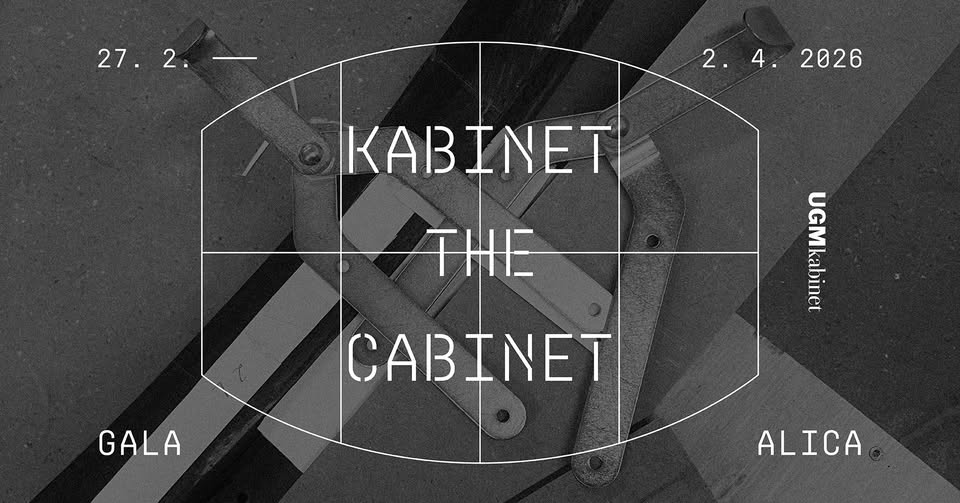
Gala Alica / Kabinet
27. februarja ob 19:00 - 20:00
[ENG below]
Gala Alica / Kabinet
UGM Kabinet, Strossmayerjeva ulica 6
27. februar – 2. april 2026
otvoritev: petek, 27. februar, 19.00
kurator: Tevž Logar
Umetniška praksa Gale Alice temelji na natančnem, skoraj arheološkem opazovanju grajenega okolja, skozi katero razpira vprašanja, kako se posameznik giblje med nenehno spreminjajočimi se mejami zasebnega in javnega prostora ter kako te meje vplivajo na občutek pripadnosti, varnosti in identitete. Pri tem jo zanimajo zgodovinske plasti prostorov, sledovi rabe in zapuščenosti ter načini, kako arhitektura strukturira vsakdanje telesne in socialne izkušnje. S tem se njeno delo približuje razmislekom, ki prostor razumejo kot polje prakse, konflikta in nenehnega prepisovanja pomenov. Njena dela pogosto vzpostavljajo subtilne situacije, v katerih se gledalec znajde v vlogi opazovalca in hkrati soudeleženca, s čimer se odpirajo vprašanja pogleda, prisotnosti in odgovornosti.
Na njene dolgoročne interese se neposredno navezuje tudi projekt v UGM Kabinetu, ki je usmerjen v raziskovanje zgodovine stavbe in njene večplastne semantične preteklosti – od religiozne prek posvetne in intimno zasebne do delovne in javne. Prostor se tu razkriva kot palimpsest, v katerega so skozi čas vpisane različne rabe, ideologije in oblike bivanja, pri čemer nobena plast ni povsem izbrisana, temveč ostaja prisotna kot sled, kot usedlina preteklih življenj prostora. Izhodišče nove intervencije je apropriacija izbranih predmetov in arhitekturnih ostankov, ki so v zadnjih petinsedemdesetih letih preživeli različna obdobja pregrajevanja, prenov in preoblikovanja prostora Umetnostne galerije Maribor.
Ti fragmenti v sebi nosijo materialni spomin nekdanjih funkcij in dejavnosti ter tvorijo arhiv stavbe, ki ni sistematiziran po logiki zgodovinopisja, temveč po logiki afekta, asociacije in prostorskega odmeva. Apropriacijo najdenih objektov dopolnjuje umetničin materialni poseg, ki se ne odvija v razstavnem prostoru, temveč v njenem ateljeju. Prav ta proces iz obstoječih sledi izrisuje nove pomene, jih prestavlja v drugačne odnose in odpira za aktualno branje, pri čemer preteklost ne nastopa kot zaključen narativ, temveč kot odprt proces. Uporaba materiala v ateljeju je ključna, saj razkriva, da Gala Alica objektov ne definira le na ravni ideje, temveč tudi skozi njihovo materialno govorico. Z uporabo sodobnih, dostopnih materialov, kot sta MDF in železo, ki zaznamujeta vsakdanjo arhitekturo urbanega okolja, vzpostavlja dialog z najdenimi objekti, katerih snov nosi sledove pretekle rabe in časa. Dodani materiali delujejo kot tihi sistemski nosilci, ki prek stikov, spojev in šivov omogočajo, da se izbrani fragmenti preteklosti ponovno umestijo v sodobni prostorski tok, ne da bi pri tem izgubili svojo zgodovinsko prisotnost.
O tem na subtilen način govori tudi naslov razstave, ki se navezuje na razstavni prostor, v isti sapi pa zrcali umetničin izrazit interes za prostor kot proces ter material kot obliko raziskovanja. Naslov v sebi nosi tudi tiho provokacijo, ki pogled usmerja k asociaciji na kabinet čudes, vendar ne skozi neposredno aluzijo na zgodovinski predhodnik sodobnega muzeja, katerega namen je bil prikazovati raznolikost in skrivnostnost sveta skozi občudovanje nenavadnih in eksotičnih predmetov. Bolj kot to gre za kritično preizpraševanje razmerja med preteklostjo in sodobnostjo, med materialom in pomenom, ter za razmislek o tem, kako se zgodovina vzpostavlja skozi konkretne stvari, njihove premestitve in ponovne kontekstualizacije.
Kabinet naseljujejo štirje objekti – natančneje, nekakšni antiobjekti – ki vsak na svoj način »spodkopavajo« specifične arhitekturne elemente razstavnega prostora: prehod, obok, tla in stene. Ti antiobjekti ne delujejo kot avtonomne skulpture, temveč kot situacije, ki razkrivajo in hkrati destabilizirajo prostorske samoumevnosti. V tem smislu lahko njihov pristop primerjamo s Sartrovim pojmom »antiromana«: z deli, ki se predstavljajo kot roman, a to formo uporabljajo predvsem zato, da jo od znotraj razgradijo in problematizirajo. Podobno ti antiobjekti na eni strani spodkopavajo idejo objekta kot stabilne, zaključene entitete, na drugi strani pa s tem spodkopavajo tudi naše predstave o prostoru, razstavi in sami instituciji.
Razstava se ne vzpostavlja kot prostor reprezentacije, temveč kot polje napetosti, v katerem se prepletajo materialni ostanki, zgodovinski odmevi in sodobne intervencije. Ne ponuja linearne pripovedi ali enoznačnega branja, temveč vzpostavlja odprto strukturo, v kateri se pomen nenehno izmika in na novo sestavlja skozi odnos med telesom, prostorom in stvarmi – kar nas približa razmisleku o rizomatskih strukturah, v katerih ni središča, temveč le mreža povezav. V tem vmesnem prostoru nastaja poetika tihega razkrivanja – poetika, ki ne gradi spektakla, temveč omogoča počasno zaznavo, dvom in ponovno premišljevanje načinov, kako prostor beremo, naseljujemo in si ga lastimo. Razstava se tako kaže kot začasna arhitektura vprašanj, ki gledalca ne nagovarja k razumevanju, temveč k izkušnji.
Razstava je nastala v okviru mreže nacionalnih in regionalnih partnerskih organizacij, katere del je tudi Umetnostna galerija Maribor. Mreža je bila vzpostavljena ob razstavi 10. trienala sodobne umetnosti – U3 | Proti toku časa v Moderni galeriji leta 2024.
Gala Alica je zaključila študij kiparstva na Akademiji za likovno umetnost in oblikovanje v Ljubljani, trenutno pa nadaljuje študij kiparstva na Univerzi za uporabne umetnosti die Angewandte na Dunaju. Izobraževala se je tudi na Univerzi za umetnost in oblikovanje v Linzu. V zadnjem obdobju se je samostojno predstavila z razstavami Small Parts, Isolated and Desired (Jochen Hempel Gallery, Leipzig, Nemčija, 2025), Not All That Persists Prevails (MoTA – Muzej tranzitorne umetnosti, Ljubljana, 2024), Stuck in Motion (Pražirna AB3, Praga, Češka, 2023), Nekogaršnja zemlja (Galerija Alkatraz, Ljubljana, 2022) in Generirani pogledi (Galerija Nočna izložba Pešak, Ljubljana, 2022). Sodelovala je na številnih skupinskih razstavah, med njimi 10. trienale sodobne umetnosti U3: Proti toku časa (Moderna galerija, Ljubljana, 2024), In the Open (Kunsthalle Exnergasse, Dunaj, Avstrija, 2023), Grit in the Eye, Stone in the Shoe (Gallery Courtney Jeager, Basel, Švica, 2023) in Rally: (Bistro21, Leipzig, Nemčija, 2022). Zaradi »relevantnosti njenega sporočila in kakovosti njenega dela« je prejela nagrado 10. trienala sodobne umetnosti U3. Mednarodno žirijo so sestavljali Anne Barlow, Bernard Blistène, Luigi Fassi, Christelle Havranek in Simone Sentall.
Več o razstavi: https://www.ugm.si/razstave/gala-alica
/ / / / / / / / / / / / / / / / / / / / / / / / / / / / / / / / / / / / / / / /
Gala Alica / The Cabinet
UGM Kabinet, Strossmayerjeva ulica 6
27 February – 2 April 2026
opening: Friday, 27 February 2026, 19:00
curator: Tevž Logar
Gala Alica’s artistic practice is rooted in precise, almost archaeological observation of the built environment. Through this approach, she examines how individuals navigate the shifting boundaries between private and public space, and how these boundaries shape experiences of belonging, safety, and identity. She is interested in the historical layering of spaces, traces of use and abandonment, and the ways in which architecture structures everyday bodily and social experience. In this sense, her work aligns with perspectives that conceive of space as a field of practice, conflict, and continual rewriting of meaning. Her works often create subtle situations in which the viewer becomes both observer and participant, prompting questions of gaze, presence, and responsibility.
These long-standing concerns are directly reflected in the project realised in the UGM Kabinet, which focuses on the history of the building and its multi-layered semantic past – from the religious, through the secular and the intimately private, to the working and the public. The space is revealed as a palimpsest, marked by successive uses, ideologies, and forms of inhabitation, none of which are ever fully erased but remain present as traces, sediments of the building’s past lives. The starting point for the new intervention is the appropriation of selected objects and architectural remnants that have survived multiple phases of partitioning, renovation, and transformation of the Maribor Art Gallery over the past seventy-five years.
These fragments carry the material memory of former functions and activities, forming an archive of the building organised not by historiographical logic, but through affect, association, and spatial resonance. The appropriation of found objects is complemented by the artist’s material intervention, which takes place not in the exhibition space but in her studio. This process draws new meanings from existing traces, shifts them into new relationships, and opens them to contemporary interpretations, in which the past appears not as a closed narrative but as an open-ended process. The use of material in the studio is crucial, as it demonstrates that Gala Alica defines objects not only conceptually but also through their material articulation. By employing contemporary, readily available materials such as MDF and steel – typical of everyday urban architecture – she establishes a dialogue with the found objects, whose material carries the traces of time and prior use. The added materials serve as quiet structural supports that, through points of contact, joints, and seams, allow selected fragments of the past to be reinserted into a contemporary spatial flow without losing their historical presence.
This approach is subtly reflected in the exhibition’s title, which refers to the exhibition space while also mirroring the artist’s strong interest in space as a process and in material as a mode of inquiry. The title also holds a quiet provocation, evoking the cabinet of curiosities without directly referencing its role as a historical precursor to the modern museum, once intended to display the world’s diversity and mystery through the admiration of unusual and exotic objects. Rather, it proposes a critical examination of the relationship between past and present, between material and meaning, and a reflection on how history is constituted through concrete things, their displacement, and their recontextualization.
The Cabinet is inhabited by four objects – more precisely, a set of anti-objects – each of which, in its own way, “undermines” specific architectural elements of the exhibition space: the passage, the vault, the floor, and the walls. These anti-objects do not function as autonomous sculptures, but as situations that both reveal and destabilise spatial conventions. In this sense, their approach may be compared to Sartre’s notion of the “anti-novel” – works that assume the form of the novel only to dismantle and question it from within. Similarly, these anti-objects challenge the idea of the object as a stable, self-contained entity and, in doing so, also unsettle our assumptions about space, the exhibition, and the institution.
The exhibition does not present itself as a space of representation, but as a field of tension where material remains, historical echoes, and contemporary interventions intersect. It offers neither a linear narrative nor a single, fixed reading, but instead creates an open structure in which meaning continually eludes capture and is reassembled through the relationship between body, space, and objects, prompting reflections on rhizomatic structures that lack a centre and consist only of a network of connections. Within this intermediate space, a poetics of gentle unveiling emerges – a poetics that does not create spectacle, but enables slow perception, doubt, and a renewed consideration of how we read, inhabit, and appropriate space. The exhibition thus appears as a temporary architecture of questions, inviting the viewer not to intellectual understanding, but to experience.
The exhibition was developed through a network of national and regional partners, including the Maribor Art Gallery, established in 2024 during the 10th Triennial of Contemporary Art – U3 | Against the Stream of Time at the Museum of Modern Art, Ljubljana.
Gala Alica studies sculpture at the University of Applied Arts die Angewandte in Vienna, and holds a bachelor’s degree in sculpture from the Academy of Fine Arts and Design in Ljubljana. She also studied at the University of Art and Design in Linz. Her solo exhibitions include Small Parts, Isolated and Desired (Jochen Hempel Gallery, Leipzig, Germany, 2025), Not All That Persists Prevails (MoTA – Museum of Transitory Art, Ljubljana, 2024), Stuck in Motion (Pražirna AB3, Prague, Czech Republic, 2023), Someone’s Land (Alkatraz Gallery, Ljubljana, 2022), and Generated Views (Night Window Display Gallery, Ljubljana, 2022). Her work has been included in several group exhibitions including the 10th Triennial of Contemporary Art U3: Against the Stream of Time (Museum of Modern Art, Ljubljana, 2024), In the Open (Kunsthalle Exnergasse, Vienna, Austria, 2023), Grit in the Eye, Stone in the Shoe (Gallery Courtney Jeager, Basel, Switzerland, 2023), and Rally: (Bistro21, Leipzig, Germany, 2022). For the relevance of her message and the quality of her work, she received the 10th Triennial of Contemporary Art U3 Award, with an international jury comprising Anne Barlow, Bernard Blistène, Luigi Fassi, Christelle Havranek, and Simone Sentall.
More at: https://www.ugm.si/en/exhibitions/exhibitions/gala-alica